Tissue Rollers: Why Balancing Is Essential for Achieving Superior Quality 🏭⚙️
Tissue Rollers used in modern production lines must deliver precision, reliability, and long-term performance. Achieving these results requires much more than high-quality materials and accurate machining processes. One of the most critical stages in manufacturing industrial rollers is balancing, a process that directly impacts the final quality and operational efficiency of the component.
Balancing is essential for ensuring that a roller rotates smoothly and consistently during operation. The goal is to eliminate or minimize any mass imbalance that could generate excessive vibrations, negatively affecting both the machinery and the finished product. 🔧
Tissue Rollers and Balancing: A Crucial Manufacturing Stage 🎯
In the tissue industry, as well as in many other industrial sectors, Tissue Rollers often operate at high rotational speeds and under demanding working conditions. Even a minor imbalance can cause unwanted vibrations, reducing production quality and increasing wear on machine components.
Balancing helps distribute mass correctly across the roller, ensuring stable rotation and improved operational reliability. This process contributes to higher productivity, fewer machine stoppages, and longer equipment lifespan. 📈
The same principle applies to Paper and Cardboard Rollers, Paper Mill Rollers, Flexible Packaging Rollers, and Printing Machine Rollers, where rotational accuracy is fundamental for maintaining product quality and production efficiency.
Static and Dynamic Balancing: Understanding the Difference ⚖️
Balancing processes can be divided into two main categories: static balancing and dynamic balancing.
Static balancing is used to correct imbalances located on a single plane. This method is particularly effective for specific types of components and allows technicians to identify imbalance points quickly and accurately.
Dynamic balancing, on the other hand, corrects imbalances occurring across multiple planes while the component rotates. This technique is particularly important for large rollers or rollers operating at high speeds. 🚀
Both methods help eliminate unacceptable vibration levels and improve the performance of Steel Rollers, Aluminum Rollers, and many other industrial roller configurations.
Tissue Rollers and Production Quality 🔍
The performance of Tissue Rollers directly influences the quality of the final product. Proper balancing offers several important advantages:
- Reduced vibration levels;
- Extended bearing life;
- Lower mechanical wear;
- Improved product quality;
- Increased production efficiency;
- Reduced maintenance costs.
These benefits are equally important for Sheet Metal Rollers, Paper and Cardboard Rollers, and Printing Machine Rollers, where stability during rotation plays a key role in overall machine performance. ✅
Zenit S.p.A.: Expertise in Industrial Roller Manufacturing 🏗️
Zenit S.p.A. operates within a production facility covering 20,000 square meters, including 10,000 square meters of covered manufacturing space. The company is organized into specialized departments that manage every stage of the production process.
The facility includes:
- Raw material warehouse;
- Tube and bar cutting department;
- Rough machining department;
- Assembly and welding department;
- Finishing department;
- Balancing department;
- Grinding department;
- Chemical and galvanic treatment department.
This integrated structure allows the production of Tissue Rollers, Paper Mill Rollers, Flexible Packaging Rollers, Sheet Metal Rollers, and many other solutions for industrial applications. ⚙️
Advanced Manufacturing Processes for High-Performance Rollers 🔩
To ensure outstanding quality standards, Zenit performs a wide range of machining operations and specialized treatments.
Key manufacturing services include:
- Tube and bar cutting;
- Turning;
- Milling on cylindrical components;
- Assembly and welding;
- Static and dynamic balancing;
- Grinding;
- Electrolytic and electroless nickel plating;
- Copper plating;
- External chrome plating;
- Heat and chemical treatments;
- Rubber and polymer coatings.
These capabilities enable the production of Steel Rollers, Aluminum Rollers, and Special Rollers and Shafts for demanding industrial environments. 🔬
Materials Selected for Reliability and Performance 🛠️
The quality and durability of a roller depend heavily on the materials used during manufacturing.
Zenit works with a broad range of materials, including:
- Carbon steels such as Fe355, C45, 39NiMo3, 42CrMo4, 100Cr6, 17NiCrMo6, and 18NiCrMo5;
- Stainless steels including 304, 316, and 420;
- Aluminum;
- Special materials such as Xm19 and K110.
This flexibility allows the company to manufacture highly resistant Ste el Rollers, lightweight Alumin um Rollers, and customized Speci al Rollers and Shafts tailored to specific production requirements.
Professional Balancing for Industrial Rollers 📊
One of Zenit’s strengths is its dedicated balancing department.
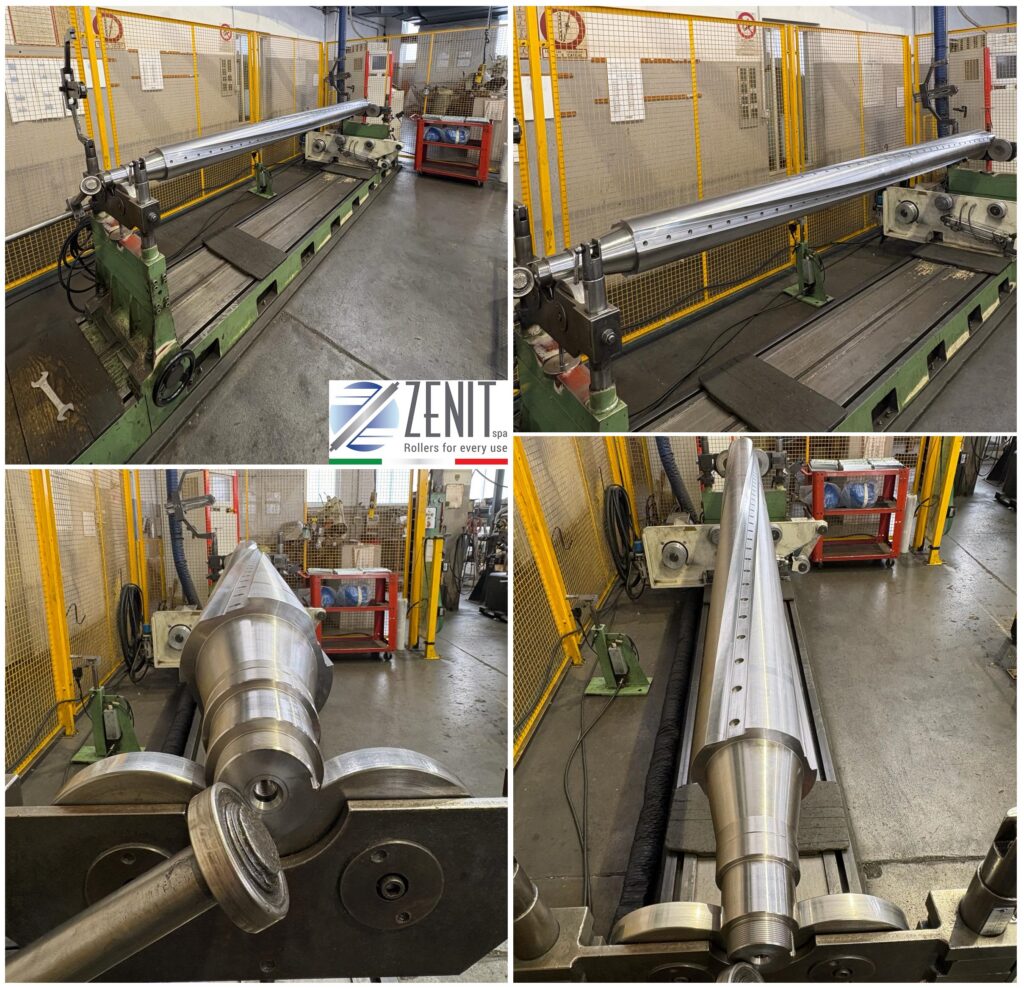
The company operates three automatic Cemb balancing machines capable of handling components with:
- Maximum diameter: 1,000 mm;
- Maximum length: 10,000 mm;
- Maximum weight: 5,000 kg.
These capabilities make it possible to balance Tissue Rol lers, Paper Mill R ollers, Flexible Packaging Ro llers, and Printin g Machine Rollers with exceptional precision.
By eliminating mass imbalances, the balancing process improves dynamic performance and ensures smooth operation throughout the roller’s service life. 📌
From Raw Materials to Finished Components 🏭
Zenit’s raw material warehouse covers approximately 4,000 square meters and maintains a large stock of tubes and bars ready for machining according to customer specifications.
The company also operates specialized departments for cutting, turning, milling, welding, grinding, and surface treatments. This complete manufacturing structure supports the production of Sheet M etal Rollers, Paper and Cardboard Roll ers, Special Rolle rs and Shafts, and numerous other industrial components.
Additional services include:
- Technical support after order completion;
- Technical drawing development;
- Prototype studies in collaboration with customers;
- Supply of raw materials such as tubes and bars.
Conclusion
The quality of an industrial roller depends on much more than machining accuracy and material selection. Proper balancing is one of the most important stages in the manufacturing process, helping reduce vibrations, improve reliability, and increase operational lifespan.