Sheet Metal Rollers: Precision Machining of Hardened Rollers with a Tapered Barrel
Sheet Metal Rollers: a high-precision machining process
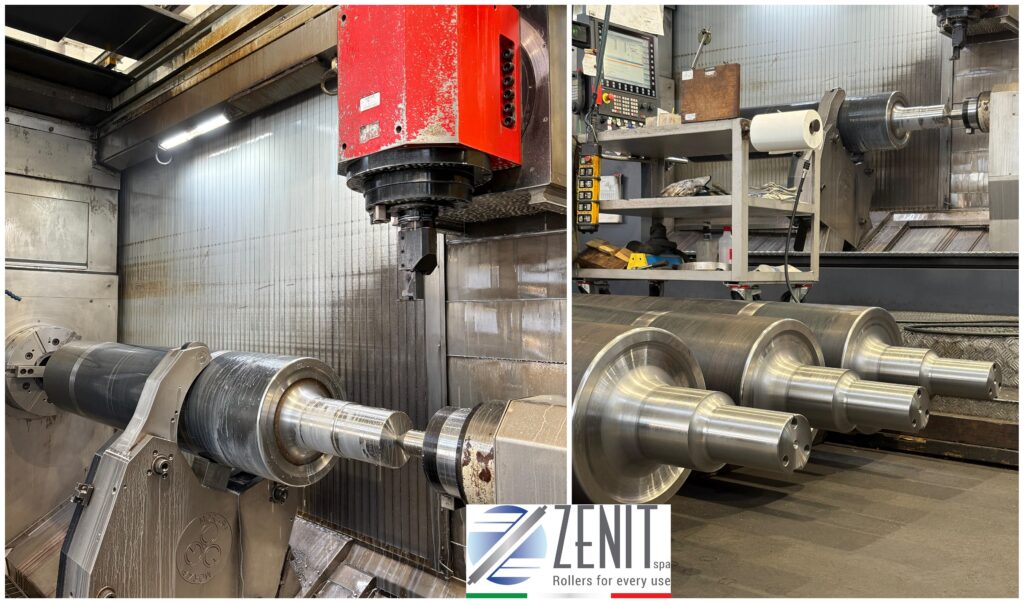
The machining of four hardened Sheet Metal Rollers is a concrete example of how mechanical precision can become essential when geometry, heat treatment and surface finishing must work together without room for error. In this case, the feature that makes the production particularly interesting is the presence of a tapered barrel, a geometric characteristic that requires constant control throughout all stages of the manufacturing process. 🔧
This is not simply a matter of producing a cylindrical surface. Instead, the barrel has a defined variation in diameter and must follow a precise geometry. The situation becomes even more complex because the surface has been hardened: the material therefore has hardness characteristics that make subsequent operations considerably more demanding than machining an untreated component. ⚙️
The combination of a tapered geometry and a hardened surface requires experience, suitable machinery and strict control of the machining parameters. To achieve the required result, it is essential to control dimensions, concentricity, taper progression and surface quality, progressively checking the component throughout the production cycle.
The tapered barrel: a detail that changes the machining process
In Sheet Metal Rollers, the geometry of the barrel can play an essential role in the behaviour of the component during the industrial process. A tapered barrel does not have a constant cross-section along its entire length: the diameter changes according to a predefined value and must accurately follow the geometry specified in the technical drawing.
This detail may appear relatively minor when considered only from an aesthetic point of view, but from a manufacturing perspective it significantly changes the machining process. Every variation must be controlled to ensure that the final surface complies with the required profile. 📐
The difficulty increases further when the barrel has already undergone hardening. The increased surface hardness obtained through heat treatment is an important requirement for many industrial applications, but it makes subsequent machining and finishing operations more demanding. The process must therefore be carried out with great care, avoiding unwanted changes to the geometry while maintaining consistent quality across the entire surface.
For this type of component, Steel Rollers are often selected when high mechanical performance, wear resistance and operational stability are required. In this specific case, the presence of hardening adds another level of complexity to the finishing stage.
Machining a hardened surface with precision
Hardening changes the characteristics of the material and increases its surface hardness, making subsequent machining operations particularly demanding. On a tapered barrel, this aspect becomes even more important because it is not enough to obtain a regular surface: the required geometric progression must also be maintained.
Precision is therefore achieved through careful control of the different stages. The objective is to maintain the correct relationship between diameters, barrel length and taper variation, reaching the required finish without compromising the results achieved during the previous operations. 🛠️
Another fundamental aspect concerns the stability of the component during machining. A component of this type must be handled in a way that minimises vibrations and variations that could affect the final surface. Even a small deviation can become significant when machining a hardened surface and when particularly tight tolerances are required.
For this type of component, experience in the production of industrial rollers makes it possible to approach these conditions through progressive inspection. It is not enough to perform a final measurement: quality control must accompany the production cycle so that any deviations from the required dimensions can be identified and addressed promptly.
Four rollers, one production challenge
Machining four components with the same characteristics also highlights the importance of repeatability. When an order includes several identical or closely related rollers, every component must achieve the same level of precision and surface quality.
Repeatability is particularly important in sectors where components operate within the same machine or are used sequentially. Consistent results help maintain stable performance and reduce the risk that dimensional differences could affect the production process. 🎯
The same attention is applied to many other types of industrial components. Tissue Rollers, for example, require surfaces and characteristics suited to the specific needs of the production process. Similarly, Aluminium Rollers may be selected when weight reduction is an important factor. Each material and application therefore involves different production conditions.
Precision, experience and surface control
When dealing with hardened rollers, surface quality cannot be considered separately from geometric precision. A properly machined surface must maintain the required characteristics across the entire barrel without losing the specified profile.
This principle also applies to Paper and Board Rollers, where surface regularity can be important to ensure uniform contact with the material. In Paper Mill Rollers, operating conditions may also require specific characteristics related to resistance, surface finish and component durability. 📄
In the case of the four rollers with a tapered barrel, the challenge is precisely to combine these aspects: hardness, geometry, surface finish and repeatability. The machining process must comply with the technical drawing without simplifying a shape that, by its very nature, requires accurate control.
The production of special components
The ability to handle non-standard geometries is an important aspect of manufacturing components for industry. Alongside rollers intended for sheet metal applications, there are many applications requiring different materials, dimensions and machining processes.
Special Rollers and Shafts represent a category in which precision and customised machining play a particularly important role. Similarly, Flexible Packaging Rollers must meet the specific characteristics of the machines in which they are installed, while Printing Machine Rollers require great attention to surface quality and dimensional accuracy. 🏭
Paper and Board Rollers and Tissue Rollers also belong to sectors where surface finish and component regularity can directly influence the production process. The manufacture of industrial rollers therefore requires the ability to adapt machining processes to the actual characteristics of each component rather than applying a single method to different products.
The value of precision in industrial manufacturing
The machining of four hardened Sheet Metal Rollers with a tapered barrel demonstrates how a geometric detail can transform a standard mechanical operation into a highly technical manufacturing process. The presence of hardening makes the surface more difficult to machine, while the tapered shape requires continuous control of the barrel profile. 🔍
It is precisely in managing these complexities that manufacturing experience, precision and inspection become decisive. Every stage contributes to the final result, while dimensional checks make it possible to keep the process under control until the required characteristics are achieved.
The same manufacturing approach can be applied to numerous industrial sectors, from Steel Rollers intended for demanding applications to Aluminium Rollers, where weight is an important factor. In the paper industry, Paper Mill Rollers and Paper and Board Rollers may require specific machining processes and surface finishes, while in the printing sector, Printing Machine Rollers must provide high precision during operation. 📈
A complex machining process, a controlled result
The four components described in this project are a concrete example of how manufacturing an industrial roller can require specific expertise when geometry and material characteristics increase the level of difficulty.
The tapered barrel, combined with the hardened surface, requires an extremely precise machining process. The final result does not depend on a single operation, but on the ability to control the entire process, from component handling to dimensional inspections and final finishing.
For Zenit S.p.A., carrying out this type of machining means combining experience, technical expertise and manufacturing capabilities to produce components for a wide range of industrial applications. Precision is therefore not an additional feature, but a fundamental part of the manufacturing process. ⚡
From sheet metal to paper, from packaging to printing, every application requires rollers with characteristics suited to its specific use. The production of Flexible Packaging Rollers, Printing Machine Rollers, Tissue Rollers and Special Rollers and Shafts demonstrates the wide variety of requirements found across different industrial sectors.
In this context, the machining of four hardened rollers with a tapered barrel represents a technical challenge addressed through precision, inspection and attention to detail: the key elements that make it possible to transform a complex specification into a finished component ready to be integrated into the production process. 🚀