Tissue Rollers: Quality Control Throughout Every Stage of Production
Tissue Rollers and quality control are closely connected when precision, production continuity and reliability must be guaranteed in every detail. In the industrial sector, it is not enough to inspect the product only at the end of the manufacturing process: quality is built throughout production and must be monitored step by step. 🔎
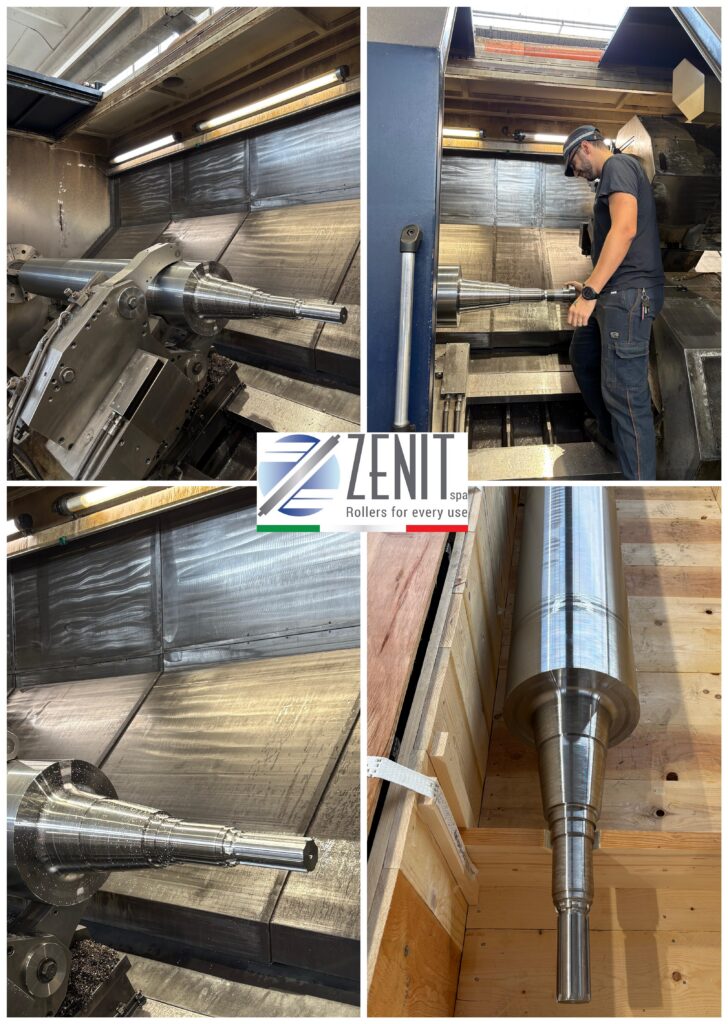
At Zenit S.p.A., this means combining final inspections with checks carried out directly on the machine, thanks to specialized operators who can perform dimensional and functional checks throughout the different manufacturing stages. 📏
The principle is simple: identifying a possible deviation at an early stage makes it possible to intervene before it can affect subsequent operations. This approach applies to Tissue Rollers, but also to many other types of industrial rollers manufactured for different sectors.
Tissue Rollers: precision is checked throughout production
The manufacturing of an industrial roller involves several operations, each of which can influence the final result. For this reason, dimensional inspection is not considered a separate activity from production, but an integral part of the daily manufacturing process.
During machining, operators can check diameters, lengths, concentricity, tolerances and other parameters specified in the technical drawing. ⚙️ These inspections allow the component to be progressively compared with the required specifications and the machining process to remain under constant control.
The same approach is applied to steel rollers, aluminum rollers and components intended for machinery where even a small dimensional variation can affect overall performance.
On-machine inspection therefore makes it possible to identify and address potential deviations promptly, without necessarily waiting until the entire production cycle has been completed. The operator’s experience plays an important role because measurement results must be interpreted in relation to the machining operation being performed.
From intermediate inspection to final quality control
Final inspection naturally remains essential. Before delivery, the product undergoes the necessary checks to verify compliance with the requested specifications. However, reaching the final inspection stage with a process that has already been monitored provides a more complete approach to quality. ✅
The difference lies in continuity: the objective is not simply to inspect what has already been manufactured, but to monitor how the product is taking shape throughout the manufacturing process.
This approach is particularly important when manufacturing sheet metal rollers, paper and cardboard rollers and rollers for paper mills, applications characterized by different technical requirements but sharing the need for precision and reliability.
Every inspection becomes a control point within the manufacturing process. If a measurement does not meet the specified tolerance, the operator can identify the deviation, assess the situation and take the necessary action during production. 🛠️
The experience of specialized operators as part of quality
Technology provides increasingly accurate measurement tools, but the expertise of people remains essential. A specialized operator does not simply read a measurement: they understand the machine, know the machining process and are able to interpret the result within its specific production context.
The combination of measuring equipment, experience and attention to detail makes it possible to monitor every stage more effectively. This is particularly important for products used in machinery where geometrical accuracy, balance and surface finish must work together.
The same philosophy applies to flexible packaging rollers and printing machine rollers, where consistency in the characteristics of the component can contribute to the regularity of the overall industrial process. 🎯
Inspection also means prevention
An inspection performed during machining does not simply certify a result that has already been achieved. Its most important function is preventive.
Measuring a dimension after a specific machining operation makes it possible to determine whether the process is proceeding as required. In this way, inspection becomes an operational tool that helps reduce the risk of a small deviation becoming a more complex non-conformity later in the process.
At Zenit, this attention to detail is applied to the production of Tissue Rollers and to all the other types of industrial components manufactured in-house. 🔧
From special rollers and shafts to components intended for paper and industrial processing applications, every category requires checks consistent with its specific technical characteristics.
Controlled production at every stage
Quality does not depend on a single operation, but on the ability to maintain consistency throughout the entire manufacturing cycle. Cutting, machining, turning, milling, grinding, balancing and surface treatments may all require specific inspections depending on the component and its required characteristics.
For this reason, Zenit integrates inspection into the production process, combining on-machine checks with final measurements. 📐
The same principle applies to steel rollers and aluminum rollers, where the ability to progressively check dimensions allows the component to remain under constant control during machining.
It also applies to paper and cardboard rollers, where requirements may vary depending on the application, dimensions and characteristics of the machine on which the component will be installed.
Precision, control and responsibility
Every roller comes with a specific set of requirements that must be respected. Dimensional inspection is therefore a responsibility involving people, machinery and procedures.
The presence of specialized operators on the machines makes it possible to combine the precision of measuring equipment with practical production knowledge. This combination allows Zenit to carry out continuous and concrete checks throughout the manufacturing process.
For rollers for paper mills, for example, as well as for sheet metal rollers, the required characteristics may differ, but the principle remains the same: inspect during production and confirm the final result.
Final inspection therefore becomes the last step of a wider control system that has already been implemented throughout manufacturing. 🔍
A quality philosophy applied across multiple categories
The experience gained in manufacturing different types of industrial components allows Zenit to apply this philosophy across numerous sectors. From Tissue Rollers to flexible packaging rollers, including printing machine rollers, special rollers and shafts, and solutions for paper, cardboard and sheet metal processing, every product is monitored according to its specific characteristics.
There is therefore no single inspection method that applies to every component. Instead, different criteria, instruments and skills are applied according to the specific requirements of each manufacturing process. 👷
This is the value of on-machine inspection: rather than waiting until the component is finished to discover a potential problem, production is supported by continuous checks throughout the process.
Tissue Rollers and quality: the value of continuous inspection
Manufacturing industrial rollers means paying attention to every stage, from the first machining operation through to the final inspection. Dimensional checks performed directly on the machine are a concrete part of this approach, allowing operators to monitor the process while the component is being manufactured.
For Zenit S.p.A., quality is therefore not simply the result of the final measurement. It is the outcome of a manufacturing process based on experience, control and responsibility. 💡
From steel rollers to aluminum rollers, from paper and cardboard rollers to rollers for paper mills, and from sheet metal rollers to the many other industrial categories served by Zenit, the objective remains the same: keep every stage under control and carefully verify the final result.
Because a reliable industrial component is also the result of knowing how to control it while it is being manufactured.