Paper and cardboard rollers: large-diameter turning for the paper industry
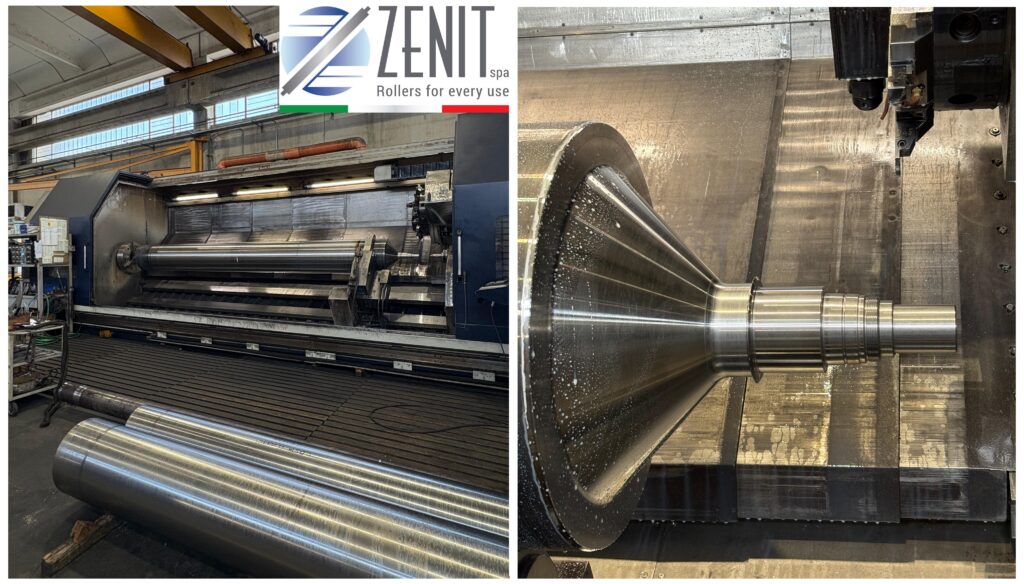
Paper and cardboard rollers in large dimensions require precise machining, constant control and suitable production capabilities to handle components with significant weight and dimensions. We are currently turning a roller intended for the paper and cardboard industry: 6 metres long and 500 mm in diameter. ⚙️
This machining process clearly demonstrates how production capacity and experience in industrial mechanics are essential when working with large components.
Turning a roller with these characteristics is not simply a matter of removing material. Each stage must be performed while constantly controlling geometry, concentricity, cylindricity and surface finish, because even small variations can affect the behaviour of the component once installed in the machine.
Turning a 6-metre-long roller
When machining a component that is 6,000 mm long, its dimensions become an integral part of the production challenge. 📏
The length of the workpiece requires particular attention during positioning and machining, especially to maintain stability and ensure uniformity along the entire roller surface.
In this specific case, the 500 mm diameter is another important factor to consider when managing the machining process. The objective is to obtain a regular surface and the required geometry while continuously monitoring the workpiece throughout the different stages.
This is precisely where experience in manufacturing paper mill rollers becomes particularly important. The requirements of paper production and converting machinery can vary considerably and require components manufactured according to precise specifications.
From raw material to finished component
The production of large industrial rollers begins with the correct management of the material and continues through several machining operations.
Turning is one of the fundamental processes because it allows the geometry of the roller surface to be defined and prepares the component for any subsequent operations.
Depending on the application, grinding, special machining operations or surface coatings may also be required. 🛠️
In the paper and cardboard industry, the roller surface may come directly into contact with the material or perform functions such as conveying, guiding, pressing or handling.
For this reason, the choice of surface finish must always be consistent with the final application.
The same attention is applied to the production of steel rollers, widely used when strength, dimensional stability and resistance to industrial working conditions are required. At the same time, in applications where weight and specific material characteristics are important, aluminium rollers can also be used.
Paper and cardboard rollers for different industrial applications
The paper and cardboard industry includes numerous processes and machines, meaning that the characteristics required from rollers can vary significantly.
Zenit manufactures different types of components for manufacturers and users of machinery for paper and cardboard production and processing: rubber-coated rollers, engraved rollers, plate mounting rollers, die-cutting rollers, anvil rollers, creasing rollers, guide rollers, transport rollers and other solutions on request.
Rubber-coated rollers, for example, can perform traction, conveying and pressure functions. Their contact surface can be coated with different materials, including silicone, Hypalon, polyurethane, neoprene, EPDM, Viton and other elastomers.
Tissue rollers represent another application in which surface precision, coating characteristics and behaviour during rotation can play a fundamental role. Here too, manufacturing must be adapted to the characteristics of the machine and the process in which the component will be used.
Precision even on large dimensions
One of the characteristics that distinguishes the production of large industrial components is the need to maintain precision along the entire length of the workpiece.
On a 6-metre-long roller, the surface to be controlled is extensive. 🔍
The machining process must therefore be carried out with particular attention to obtain uniform geometry and comply with the required tolerances.
This aspect is also important for sheet metal rollers, where surface continuity and geometric precision can be decisive for the correct operation of the machine.
The same principle applies to steel rollers intended for different industrial applications: the size of the component must not become a limitation to machining quality.
Paper mill rollers and customised solutions
Machines used in paper mills can require rollers with very different characteristics.
A guide roller, for example, must guide the material while keeping it on the correct path. The roller surface can be cylindrical, conical, concave or convex, produced through turning or grinding operations.
A transport roller, on the other hand, must ensure consistent behaviour while the material is being moved, whereas a rubber-coated roller may be used for traction or to apply a specific pressure.
For this reason, paper mill rollers cannot all be considered the same: diameter, length, material, roller geometry, finish and coating are selected according to the intended application.
Flexible packaging rollers also require specific characteristics, particularly when they need to ensure accurate and consistent material transport along the production line.
Materials and coatings
Material selection is another important aspect in the production of industrial rollers.
Steel is used in many applications thanks to its mechanical properties and the possibility of carrying out different machining and treatment processes.
Aluminium rollers, on the other hand, can be particularly interesting when it is necessary to reduce component weight while maintaining high precision.
Depending on the application, different surface treatments and coatings can also be provided, including chrome plating, nickel plating, anodising, ceramic coatings, polyurethane, rubber and non-stick materials.
The roller surface is therefore manufactured by considering not only its appearance, but above all its interaction with the material and the operating conditions.
Paper and cardboard rollers: beyond turning
Turning is a fundamental stage, but the production of a large industrial component involves a broader range of expertise.
From material handling to machining, from dimensional inspection to possible finishing operations, every stage contributes to the final result. ⚙️
For particular applications, special rollers and shafts may also be required, manufactured according to dimensional and functional specifications defined by the customer.
These components can be intended for different types of machinery and may require special machining operations, specific geometries or combinations of materials and treatments.
The same production capabilities can be applied to printing machine rollers, where precision, surface uniformity and dimensional stability are fundamental aspects for machine operation.
Production capabilities for large components
The ability to machine components up to 7,000 mm in length and 1,000 mm in diameter allows Zenit to handle machining operations involving significant dimensions.
The roller currently being turned, measuring 6 metres in length and 500 mm in diameter, is a concrete example of this production capability. 🏭
The challenge is not simply being able to machine a large component, but being able to manage the entire process while maintaining constant attention to the required precision.
This expertise can be applied across numerous industrial sectors, from paper and cardboard to Tissue, printing, sheet metal processing and flexible packaging.
Paper and cardboard rollers: experience, precision and production capacity
The production of paper and cardboard rollers in large dimensions therefore requires a combination of experience, technology and production capacity.
The 6-metre roller currently being machined is a concrete example of how a turning operation can transform a large component into a finished element ready to become part of an industrial machine.
From guide rollers to transport rollers, from rubber-coated rollers to components intended for die-cutting and creasing, every application presents different requirements.
The production of flexible packaging rollers, printing machine rollers, Tissue rollers and special rollers and shafts further expands the range of industrial applications.
Sheet metal rollers, steel rollers and aluminium rollers are also part of a production approach focused on industrial components characterised by different dimensions, materials and operating conditions.
📐 6 metres long. 500 mm in diameter. A turning operation that clearly demonstrates Zenit’s ability to machine large industrial components with precision and consistency.
It is precisely the combination of experience in mechanical machining, process control and production capacity that creates the value of a roller designed to operate inside an industrial machine.