Special Rollers and Shafts: Blade Grinding and Precision Components
Special rollers and shafts play an important role in the production of components for industrial processes where precision, strength and repeatability must work together. In these applications, reaching the grinding stage means dealing with one of the most delicate finishing operations: when the component incorporates a blade or a surface intended for cutting, even a small geometric variation can affect the final result.
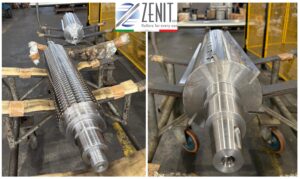
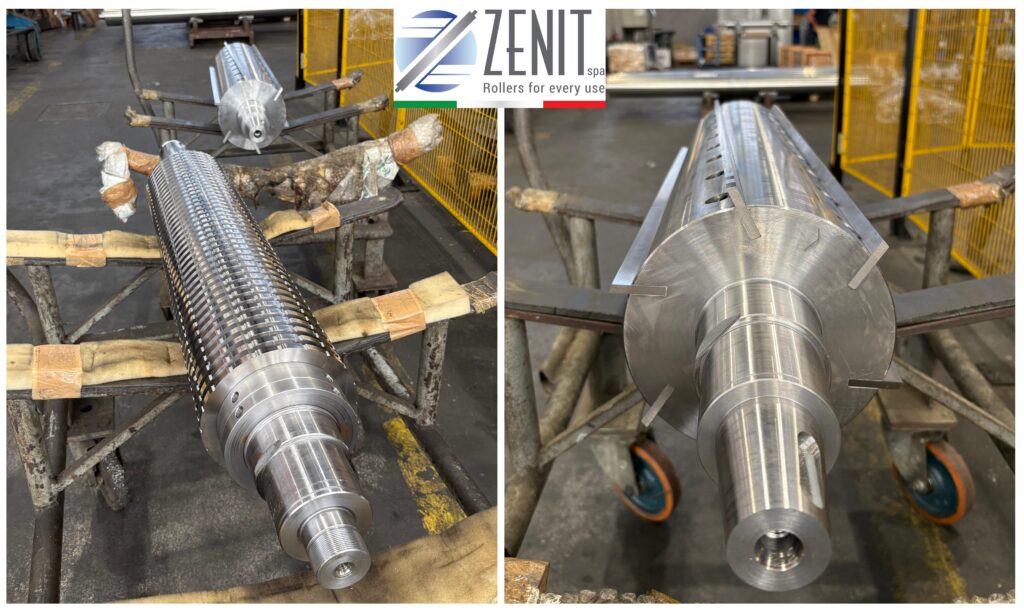
In the case presented here, the machining process concerns K110 blades, a material characterized by high hardness, on which we carry out the final grinding of both the diameter and the cutting edge. ⚙️ Accurate control of these dimensions is essential to achieve precise shredding of plastic material and to produce pellets with consistent dimensions.
Final Grinding: Precision Where Cutting Becomes Critical
Grinding is not simply a surface finishing operation. It is the stage in which the geometry achieved during the previous machining operations is brought to the required level of precision. For this reason, blade machining requires careful control of both the diameter and the shape of the cutting edge.
A blade used for shredding must operate smoothly and consistently. Diameter accuracy contributes to the correct coupling between the machine components, while the cutting-edge geometry determines how the material is intercepted and reduced. 🔧
We grind components made from different types of materials and with different diameters, adapting the machining process to the characteristics of each component. In the case of K110 blades, the high hardness of the material makes accurate control of the final machining particularly important.
Blade Holder Rollers: Precision in the Seat and Clamping System
Blade holder rollers are characterized by grooves or milled seats on the roller surface, with different shapes depending on the system used to secure the blade. Their function can be either clean cutting of the product or scoring, depending on the industrial process in which they are used.
The area intended for the blade must therefore be machined with great care. In addition to the milled seat designed to accommodate the blade, the roller can feature wedge-type clamping systems or solutions using simple screws. Correct machining of these seats allows the blade to maintain its intended position during operation.
Since the roller surface is normally not in direct contact with the product, it is usually finished by turning. When greater surface protection is required, we can provide specific treatments, including hard chrome plating followed by grinding, non-stick coatings, carbide coatings and ceramic coatings. 🛠️
Shredder Rollers for Material Reduction
Shredder rollers share many construction characteristics with blade holder rollers, but differ mainly in the configuration of the blade, which is mounted with a straighter inclination. Their purpose is to shred the product and reduce it to the required dimensions, making these components an important part of the material reduction process.
Here too, machining accuracy plays a central role. Correct geometry allows the different components to maintain a controlled relationship during operation and contributes to more uniform shredding. ♻️
The roller surface can be finished by turning and, when operating conditions require it, protected with hard chrome plating followed by grinding or with non-stick, carbide or ceramic coatings. The choice of surface treatment depends on the material being processed and the operating environment.
Special Rollers and Shafts: Solutions for Different Machining Applications
Our production includes numerous configurations of special rollers and shafts, manufactured for applications in which the function of the component requires precise mechanical machining and specific material characteristics.
These include shafts dedicated to the perforation sector. Their purpose is to transmit motion from the motorized section to the actual processing and suction section. Their geometry may require different precision machining operations, carried out according to the customer’s specific requirements. 🔩
Our ability to perform turning, milling, grinding, balancing and complementary machining operations allows us to manufacture components for different industrial processes while maintaining coordinated control of the various production stages.
Special Rollers and Shafts: Materials and High-Strength Applications
Another application concerns shafts for butterfly valves, which are used to transmit movement from the actuator to the disc and regulate the flow of gaseous or liquid fluids inside a pipeline.
These shafts consist of a high-strength monobloc stem and feature keyway seats that allow the connection between the stem and the disc. Due to the high precision required, the stems undergo final grinding.
When the component operates in environments subject to severe corrosion, we can machine materials such as stainless steels, duplex, superduplex, Inconel and XM19. 🧪 Material selection is an integral part of manufacturing the component, as it must take into account operating conditions and the performance requirements of the application.
Steel Rollers, Aluminium Rollers and Special Materials
The variety of materials we can machine allows us to address many different applications. We manufacture steel rollers for numerous industrial uses and aluminium rollers when different characteristics are required in terms of weight and component performance.
Steel rollers can be manufactured using carbon steels such as Fe355, C45, 39NiMo3, 42CrMo4, 100Cr6, 17NiCrMo6 and 18NiCrMo5, as well as stainless steels such as 304, 316 and 420. For specific applications, we also machine special materials including XM19 and K110.
Aluminium rollers are used when weight reduction is an important factor. The availability of different materials allows us to manufacture rollers and shafts for industries where precision, strength and reliability must be considered together. ⚙️
Rollers for Sheet Metal, Paper, Tissue and Other Industrial Sectors
Our expertise in machining cylindrical components also allows Zenit S.p.A. to manufacture rollers for sheet metal, rollers for paper and cardboard and rollers for tissue applications. Each sector has specific requirements, but all of them demand dimensional control, surface quality and long-term reliability.
Rollers for sheet metal are used in processes where component geometry contributes to the correct handling of the material. Rollers for paper and cardboard require particular attention to surface finish and consistency, while rollers for tissue are used in processes where lightness, precision and regularity can be particularly important.
Our experience also includes rollers for paper mills, rollers for flexible packaging and rollers for printing machines, components intended for different production lines but sharing the need for accurate and repeatable machining. 📐
Rollers for Paper Mills, Flexible Packaging and Printing
In the paper industry, rollers for paper mills must maintain dimensional and surface characteristics consistent with the process in which they are installed. In packaging systems, rollers for flexible packaging may be required to operate with different materials and under different conditions, while rollers for printing machines must contribute to process stability and printing precision.
Likewise, rollers for sheet metal, rollers for paper and cardboard and rollers for tissue may require different configurations, materials and surface treatments. The common factor is the ability to control the different production stages, from raw material to final finishing. 🔍
Zenit S.p.A.: Departments and Machining Operations for Special Components
Zenit S.p.A. operates in a 20,000 m² facility, including 10,000 m² of covered production space, organized into departments dedicated to the different production stages:
• raw material warehouse
• tube and round bar cutting
• rough machining
• assembly and welding
• finishing
• balancing
• grinding
• chemical and galvanic treatments
This organization allows us to manage numerous machining operations and maintain coordinated control of the component throughout its production process. 🏭
The machining operations we carry out include tube and round bar cutting, turning, milling on cylindrical components, assembly and welding, static and dynamic balancing, grinding, galvanic and chemical nickel plating, galvanic copper plating, external chrome plating, external heat and/or chemical treatments, and external rubber and polymer coatings. Further external treatments are available upon request.
The Importance of Final Grinding
In the case of K110 blades, grinding represents the operation that brings the component to its final configuration. This is where diameter and cutting-edge accuracy become directly connected to the quality of the shredding process and to the possibility of producing plastic pellets with controlled dimensions. 🎯
It is a concrete example of how a finishing operation can have a decisive impact on the performance of an entire industrial process. For this reason, we manufacture components according to the required specifications, working with different materials and providing complementary services such as post-order technical support, technical drawings, prototype studies in cooperation with the customer, and the supply of raw materials, tubes and round bars.
The production of special rollers and shafts requires a comprehensive approach: from material selection to mechanical machining, from grinding to surface treatments and final inspection. With this approach, Zenit S.p.A. supports customers in the manufacture of components for industrial processes where precision and reliability make the difference. 🚀