Steel Rollers with FDA-Compliant Rubber: 500 mm Diameter
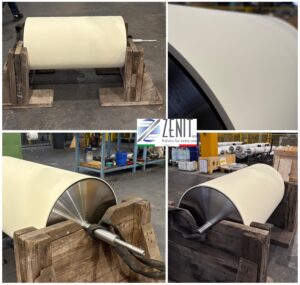
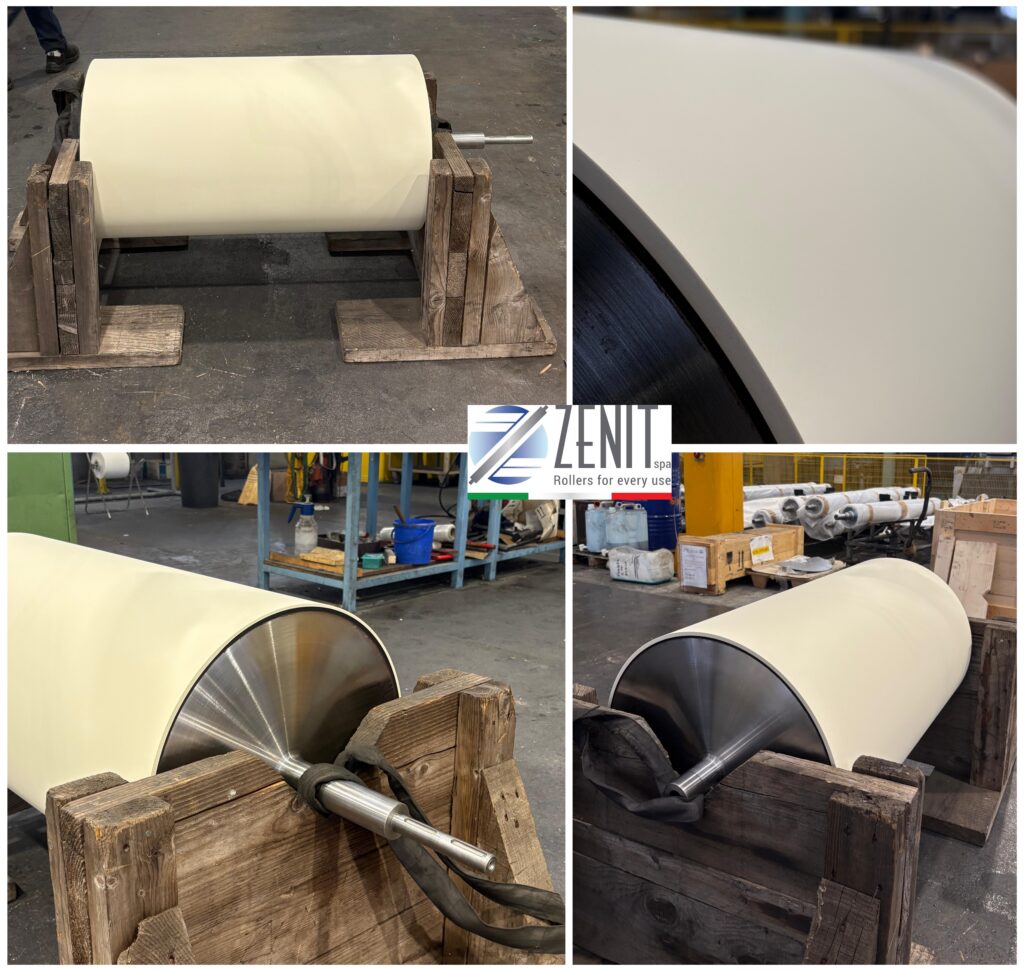
Steel Rollers with rubber coatings for industrial applications requiring specific material properties and attention to food-contact requirements: Zenit S.p.A. has recently completed the production of rubber-coated rollers with a diameter of 500 mm, featuring a rubber compound compliant with the applicable FDA requirements for its intended use.
This latest achievement highlights Zenit’s manufacturing capabilities and its attention to material selection, machining quality and the characteristics of industrial components. 🔧
Steel Rollers with Rubber Coatings: Why Material Selection Matters
In industrial manufacturing, selecting a roller involves much more than considering its dimensions or mechanical strength. The surface coating can play a decisive role in the component’s performance, particularly when specific requirements apply to the product being processed or to food-contact applications.
Rubber-coated rollers combine a metal structure with the properties of an external elastomeric layer. Steel provides a robust supporting structure, while the rubber coating can deliver the surface characteristics required by the production process.
The choice of rubber compound, hardness and coating properties must be consistent with operating conditions, the type of material being processed and any applicable hygiene or food-contact requirements.
In Zenit’s latest production, the 500 mm diameter is a distinctive feature. Manufacturing components of this size requires careful attention to dimensional accuracy, coating quality and the finished surface.
The result is an industrial component in which the metal structure and rubber covering must work together to meet the technical requirements of the intended application. ⚙️
FDA-Compliant Rubber: Requirements for Food Contact
When a roller is used in a process involving food contact, material selection requires specific verification. Mechanical strength and surface quality alone are not sufficient: the materials must also be assessed against the applicable regulatory requirements.
In the United States, an important regulatory reference is 21 CFR § 177.2600, which addresses rubber articles intended for repeated use. This provision establishes requirements concerning the substances used in rubber articles and limits on extractives for products intended to contact food repeatedly. It distinguishes between contact with aqueous foods and contact with fatty foods.
The official regulation is available here: https://www.ecfr.gov/current/title-21/chapter-I/subchapter-B/part-177/subpart-C/section-177.2600
Compliance depends on the rubber formulation, the substances used and the intended conditions of use. Depending on the application, specific material documentation and verification may therefore be necessary.
It is important to understand that FDA compliance is not a generic designation that automatically applies to every rubber compound or every possible application. The selected compound must be suitable for its intended use, and the applicable conditions must be met.
For industrial manufacturers and their customers, this documentation is essential when assessing whether a material is appropriate for a particular process. It helps establish the basis for evaluating the compound against the requirements specified for the application.
Zenit’s Latest Production: Rubber-Coated Rollers with a 500 mm Diameter
The recently completed production demonstrates Zenit S.p.A.’s experience in manufacturing industrial components to specific technical requirements. The rollers, measuring 500 mm in diameter, feature a rubber coating made with a compound compliant with the applicable FDA requirements for its intended use.
In this type of manufacturing process, every stage contributes to the final result. Preparation of the metal substrate, application of the rubber coating and verification of the required characteristics must be considered together.
The coating must be assessed according to the function of the component. Depending on the process, important factors may include surface uniformity, rubber hardness, adhesion to the substrate and resistance to operating conditions.
Dimensions also influence manufacturing requirements. A large-diameter roller needs careful handling throughout production, together with appropriate checks of its geometry and surface characteristics.
Quality therefore depends on a combination of suitable materials, accurate manufacturing operations and inspections consistent with the agreed specifications.
For Zenit, completing a supply with these characteristics means delivering an industrial component manufactured according to the technical requirements established for the customer’s application. 🏭
Sheet Metal Rollers and Other Industrial Applications
Manufacturing rollers for different industrial processes requires careful evaluation of material properties and operating conditions. Sheet Metal Rollers, for example, may require specific surface characteristics depending on the forming process, the material being handled and the level of precision required.
The same attention applies to Special Rollers and Shafts, where geometry, dimensions, materials and surface treatments must be consistent with operating conditions.
Aluminum Rollers are another important category, particularly in applications where reducing component weight is a priority. The choice between steel, aluminum and different surface coatings depends on the function of the component and the technical requirements of the process.
For each roller type, material selection and manufacturing operations must take into account mechanical loads, the working environment and any contact with specific substances or products.
There is no single solution suitable for every industrial process. The actual operating conditions determine the most appropriate characteristics for each component.
Paper and Board Rollers, Tissue Rollers and Paper Mills
In the paper industry, component performance contributes to consistent and reliable production. Paper and Board Rollers are used in industrial lines where reliability, precision and surface properties must be assessed in relation to the manufacturing process.
Specific requirements also apply to Tissue Rollers, which are used in lines for tissue paper production and converting. In these applications, the roller must be suitable for the material being processed and the operating conditions of the equipment.
Paper Mill Rollers may require different materials, finishes and surface treatments depending on their position within the production line and the function they perform.
In these environments, manufacturing experience and knowledge of machining processes are important factors in producing components that meet the specified technical requirements.
Flexible Packaging Rollers and Printing Machine Rollers
Other industrial sectors require rollers with carefully defined surface characteristics. In converting processes, Flexible Packaging Rollers may operate under conditions where surface uniformity, dimensional stability and wear resistance are particularly important.
Similarly, Printing Machine Rollers must meet the requirements of the equipment and process, taking into account the materials involved and the operating environment.
Every application has its own technical demands. For this reason, the characteristics of a roller should be assessed according to actual operating conditions rather than treating materials and coatings as interchangeable solutions.
The ability to manufacture components in different dimensions, materials and surface finishes allows Zenit to address a wide range of industrial requirements while maintaining a focus on manufacturing quality and compliance with agreed specifications.
Manufacturing Quality and Attention to Detail 🔍
The recent production of 500 mm rubber-coated rollers illustrates the importance of coordinating the properties of the metal structure with those of the elastomeric coating.
When food-contact requirements apply, material quality must be supported by appropriate technical documentation. The rubber compound needs to be assessed against the relevant regulations and intended conditions of use. Compliance should not automatically be extended to every possible use of the finished roller without the necessary supporting evidence.
This approach allows customer requirements to be addressed with greater technical awareness, taking into account both the component itself and the environment in which it will operate.
At Zenit S.p.A., industrial roller manufacturing brings together mechanical expertise, material selection and careful production processes, with the objective of supplying reliable components that meet agreed technical specifications.
Looking for a manufacturer of rubber-coated rollers for a specific industrial application?
Zenit S.p.A. can assess your technical requirements and manufacturing needs, taking into account dimensions, materials, coating properties and expected operating conditions.
📩 For further information, contact our sales department at commerciale@zenit-spa.com.
🌐 Discover more about Zenit S.p.A. at https://www.zenit-spa.com/