Sheet Metal Rollers: Final Grinding After Rubber Coating of Heating Rollers
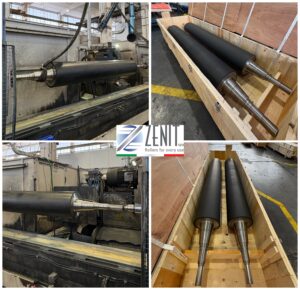
Sheet metal rollers require carefully coordinated manufacturing operations to achieve the specifications required for their industrial applications. At Zenit S.p.A., we are currently carrying out the post-rubber-coating grinding of heating rollers measuring 400 mm in diameter and 3,800 mm in length. These components are designed for sheet metal treatment lines, particularly for end-of-line applications.
This machining process represents one of the final stages of a structured manufacturing cycle. Before reaching this point, the rollers have undergone rough machining, assembly, balancing, heat treatment and finishing. The next stage was rubber coating, followed by the final operation: journal grinding.
The objective is to complete the manufacturing process while paying close attention to the component’s dimensions, machined surfaces and intended application. 🔧
Sheet Metal Rollers with Rubber Coating: From Machining to Surface Treatment
Manufacturing an industrial roller of this size requires careful coordination of the different production stages. Before reaching final grinding, the component must undergo several operations that progressively prepare its structure and surfaces for subsequent processing.
Rough machining is one of the initial stages, removing the material required to bring the component closer to its specified dimensions. The process then continues with the operations required for assembly and balancing, followed by heat treatment and finishing according to the manufacturing specifications.
Once these stages have been completed, the roller undergoes rubber coating, which introduces an important functional feature: an elastomeric covering on the working surface.
Rubber coatings can serve different purposes depending on the industrial process, the material being handled and the operating conditions. They can support material transport, provide controlled contact with the product and contribute to the interaction between the roller and the machinery.
For heating rollers used in sheet metal treatment, the role of the coating must be considered in relation to the operating environment and the requirements of the production line. 🌡️ Material selection and surface characteristics must be consistent with the intended application, including the relevant temperature and contact conditions.
Journal Grinding: The Final Manufacturing Stage
After rubber coating, these components reach the final stage of the manufacturing cycle: journal grinding. The journals are the end sections of the roller that connect with other machine components.
This operation requires particular attention because the journals perform a different function from the coated working surface. While the external surface interacts with the industrial process, the end sections must meet the dimensional requirements needed for correct assembly and operation.
Grinding makes it possible to achieve the specified finish on the relevant surfaces while controlling the dimensions and quality of the machining process. 📐 The result must comply with the manufacturing specifications and the requirements of the intended installation.
The timing of this operation is also important. Grinding takes place after rubber coating, when the roller has already passed through most of its manufacturing stages. It is therefore essential to follow the established production sequence and complete the component while respecting the characteristics of each surface.
Final grinding is an integral part of the manufacturing process and contributes to delivering a component that meets the required specifications.
Heating Rollers for Sheet Metal Treatment Lines
The rollers featured in this production stage are intended for sheet metal treatment systems, particularly in end-of-line sections. In these installations, different components must operate together as part of a coordinated industrial process.
A roller is not an isolated component: its characteristics must be compatible with the other machine elements, the material handling process and the operating conditions.
The dimensions of these rollers—400 mm in diameter and 3,800 mm in length—also highlight the importance of carefully managing the various machining and finishing stages. 📏 Manufacturing components of this type requires experience in material removal, surface processing and dimensional control.
The rubber coating introduces an additional factor to consider. The preceding and subsequent operations must be coordinated so that every part of the roller achieves the characteristics required for its specific function.
This integration of different manufacturing operations is a key feature of industrial components produced for complex machinery.
A Manufacturing Process Combining Different Skills
The production of these components highlights the importance of monitoring each stage, from initial preparation through to final machining.
Every operation has a specific purpose and contributes to the overall result. Rough machining prepares the component for subsequent stages; balancing and heat treatment address the requirements of the manufacturing cycle; finishing and rubber coating bring the roller closer to its required configuration. Journal grinding completes the process.
At Zenit S.p.A., we manufacture rollers for a wide range of industrial sectors, carrying out machining operations according to the dimensions, materials and specifications of each component. 🔩 Our production includes steel rollers, used in numerous industrial applications, and aluminum rollers, for which weight, material properties and surface finish are important considerations.
We also manufacture special rollers and shafts according to customers’ dimensional and construction specifications, as well as components for machinery used to process different materials.
Our manufacturing capabilities also include flexible packaging rollers, where surface characteristics must meet the needs of the production process, and paper and cardboard rollers, designed for production lines that require reliable components and accurate machining.
Our range also includes tissue rollers, paper mill rollers and printing machine rollers, serving industries in which component specifications vary according to the machinery and the intended process.
Sheet Metal Rollers: Precision at Every Stage
The machining of rubber-coated heating rollers demonstrates the importance of coordinating mechanical operations and surface finishing correctly. No single stage can determine the quality of the finished product on its own: the result depends on the correct execution of the entire manufacturing cycle.
For this reason, when manufacturing steel rollers and aluminum rollers, as well as components for more specialised applications, we pay close attention to material characteristics, dimensions and the required machining operations.
The same approach applies to flexible packaging rollers, special rollers and shafts, paper and cardboard rollers, tissue rollers, paper mill rollers and printing machine rollers. Different applications require versatile technical skills, appropriate machining capabilities and careful control of the finished component.
For the rollers currently being completed, the objective is to finish journal grinding after rubber coating, in accordance with the specifications required for their use in sheet metal treatment lines.
💪 From initial machining to final finishing, every operation contributes to producing a component ready for its intended industrial application. This attention to the manufacturing process guides our work on complex components, including the post-coating grinding of heating rollers measuring 400 × 3,800 mm.