Die-cutting rollers for paper and cardboard: mechanical precision and solutions for every processing stage
The production of rollers for paper and cardboard plays a fundamental role in industrial plants dedicated to the manufacturing, conversion and processing of paper-based materials. Each stage of the process requires specific mechanical characteristics, precise geometries and surfaces capable of ensuring production continuity, reliability and consistent product quality.
Numerous types of rollers are used in these plants, each performing a clearly defined function: from material transportation and guiding to printing, creasing and die-cutting. These components often feature particularly complex machining operations and require specialist mechanical manufacturing expertise.
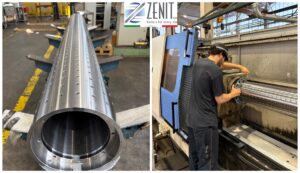
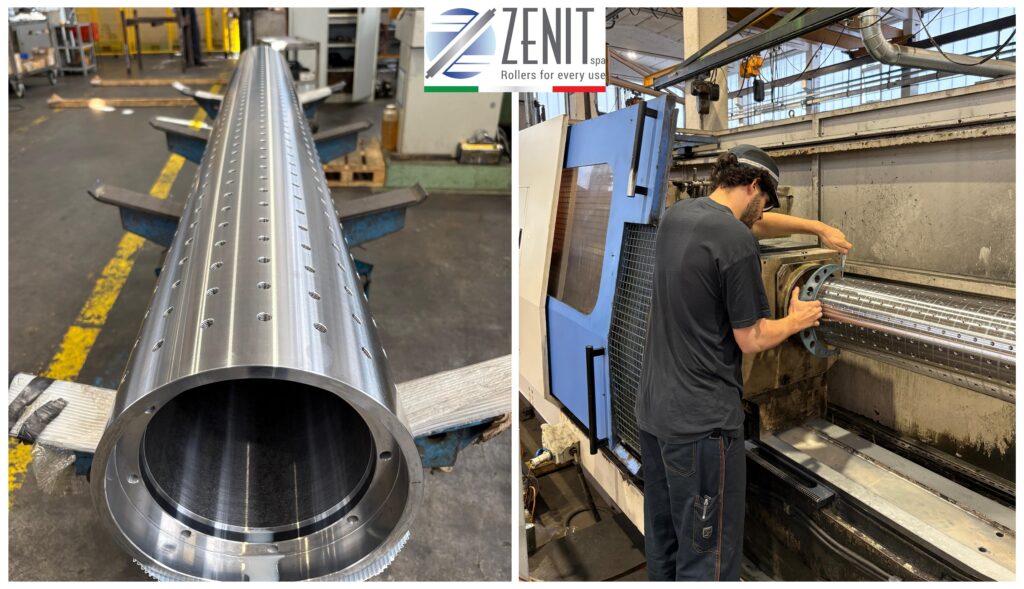
Among the most interesting examples are die-cutting rollers with a working width of 2,900 mm and as many as 1,500 M8 tapped holes distributed across the barrel. This type of manufacturing demonstrates the level of precision required when producing components for industrial cardboard converting equipment. ⚙️
Rollers for paper and cardboard: main types and their functions
Not all rollers installed in a production line perform the same task. Their configuration depends on the required operation, the material being processed and the characteristics of the machinery.
Let’s take a closer look at some of the main types manufactured for this sector.
Die-cutting rollers: precision and mounting holes
Die-cutting rollers act as supports for the cutting die, the component responsible for cutting the material and giving it the required shape.
Their distinctive feature is the presence of numerous drilled and tapped holes along the barrel, allowing the cutting and forming equipment to be securely fastened.
The hole layout must comply with precise dimensional and geometric specifications to ensure correct assembly and maintain equipment stability during operation.
A significant example is a die-cutting roller with a working width of 2,900 mm and 1,500 M8 threaded holes. Manufacturing such a component requires particular attention to machining accuracy, hole positioning and geometric inspection.
The working surface, also known as the barrel, can retain a ground finish or undergo different surface treatments:
-
Bright light chrome plating.
-
Satin light chrome plating.
-
Hard chrome plating followed by grinding.
-
Non-stick coatings.
-
Other customised solutions upon request.
The choice of finish depends on operating conditions and the characteristics of the material being processed.
Printing plate rollers: support and positioning
Printing plate rollers support the printing plate, which transfers an image or graphic onto the material during the printing process.
These components generally feature two distinctive machining characteristics.
The first is a longitudinal milling operation running along the entire barrel, designed to secure the printing plate.
The second consists of axial and circumferential reference lines across the roller surface, which help ensure accurate positioning of the printing plate.
Machining quality is essential in this application. Maintaining the required geometries and tolerances helps ensure accurate assembly and consistent repeatability throughout production.
The barrel can be ground or coated with bright or satin chrome plating, hard chrome plating followed by grinding, and non-stick treatments.
Anvil rollers: surface resistance and reliability
Anvil rollers keep the material in contact with the die-cutting roller during the cutting process. Their operation is therefore closely linked to the quality of the die-cutting process.
Surface resistance is particularly important for this application, as the component is exposed to continuous mechanical stress during production cycles.
The barrel can be manufactured with a ground finish or treated with different coatings, selected according to the operating conditions.
Available options include bright light chrome plating, satin light chrome plating, hard chrome plating followed by grinding, and non-stick coatings.
The choice of treatment helps determine long-term surface performance, wear resistance and component reliability. 🛠️
Creasing rollers: specific geometries for folding operations
Creasing rollers are used to create controlled folds in cardboard, preparing the material for subsequent converting and packaging operations.
This type of roller also features specific construction characteristics. Generally, a longitudinal milling operation is performed along the barrel to secure the creasing tool. Axial and circumferential reference lines may also be present to facilitate accurate positioning of the equipment.
The accuracy of these machining operations is essential to ensure correct alignment between the working elements and consistent results across the entire width of the material.
As with other components used in paper converting, the surface of creasing rollers can be ground or coated with chrome plating and non-stick treatments.
Guide rollers: maintaining the correct material path
As paper and cardboard travel through an industrial plant, they must follow a precise path. Guide rollers perform this function, preventing lateral movements that could compromise the process or cause machine downtime.
The barrel can feature a cylindrical, concave tapered or convex tapered geometry. These profiles are obtained through turning and grinding operations, depending on the required specifications.
To meet different operating conditions, various coatings can be applied:
-
Bright and satin light chrome plating.
-
Hard chrome plating followed by grinding.
-
Silicone and Hypalon.
-
Polyurethane and neoprene.
-
EPDM and Viton.
-
Zinc plating and painting.
-
Non-stick coatings.
The availability of different materials makes it possible to obtain surfaces with specific friction, elasticity and chemical resistance properties. 🔧
Transport rollers: production continuity
Transport rollers move paper and cardboard through the different sections of an industrial plant.
They generally feature simple journals without drive connections and are manufactured to ensure uniform support and smooth material movement.
The barrel can have a cylindrical, concave tapered or convex tapered geometry, obtained through turning or grinding operations.
Different surface treatments can subsequently be applied, including chrome plating, silicone, polyurethane, neoprene, EPDM, Viton and other specialised coatings.
Choosing the correct finish helps maintain material stability during transportation, reducing the risk of slipping or irregular feeding. 📐
Material selection and surface treatments
In addition to geometry and machining operations, the material used is another important factor in the manufacturing of industrial components.
Steel rollers are particularly suitable for applications requiring strength, rigidity and resistance to mechanical stress. Aluminium rollers, on the other hand, offer reduced weight, which is particularly beneficial when rotating masses need to be minimised.
Zenit’s manufacturing capabilities also include machining operations for flexible packaging rollers, sheet metal rollers and Tissue rollers, sectors in which surface and dimensional characteristics play a crucial role.
Another important field is the production of paper mill rollers, where components must meet the specific requirements of the different paper manufacturing and handling stages.
Our mechanical expertise also extends to special rollers and shafts, designed for specific applications and non-standard configurations.
Finally, the manufacturing of printing machine rollers requires particular attention to geometry, surface finishes and overall surface quality, all of which are essential for achieving consistent results.
The choice of coating is never a secondary detail. Chrome plating, non-stick treatments, elastomer coatings and grinding operations allow each component to be adapted to its actual operating conditions. ✨
Zenit: mechanical expertise serving industry
Manufacturing components for paper and cardboard processing machinery requires experience, precision and the ability to manage different machining operations, sometimes within a single component.
At Zenit S.p.A., we manufacture industrial rollers for numerous manufacturing sectors, handling operations ranging from standard turning and grinding to particularly complex machining processes involving multiple drilled holes, tapping, milling and specific geometries.
Our experience also includes the production of special rollers and shafts, as well as components for different industries, such as flexible packaging rollers and printing machine rollers.
Our production versatility allows us to work with different materials, from steel to aluminium, manufacturing both steel rollers and aluminium rollers according to the specific requirements of each application.
Our expertise in manufacturing sheet metal rollers, Tissue rollers and paper mill rollers further strengthens our cross-sector industrial experience, which also extends to components for the cardboard converting industry.
Each manufacturing process starts with the customer’s technical specifications, with particular attention to dimensional tolerances, machining quality and the selection of surface treatments.
Rollers for paper and cardboard: attention to detail in every machining operation
The manufacturing of these components demonstrates how even a single roller can involve a complex combination of mechanical machining operations.
A die-cutting roller with a 2,900 mm working width and 1,500 M8 holes, for example, is much more than a machined cylinder. It is a component that must ensure accurate hole positioning, reliable fastening and excellent working-surface quality.
The same principle applies to printing plate rollers, anvil rollers, creasing rollers and rollers designed for material transportation and guiding.
It is precisely this attention to detail that makes it possible to manufacture reliable components suited to the requirements of industrial machinery.
Zenit S.p.A. continues to put its mechanical expertise at the service of industry, turning technical specifications and production requirements into precision-manufactured components. 🏭