Steel Rollers: versatility across sectors, materials and dimensions
Steel rollers are at the heart of many industrial applications, but the real value of our work lies in something broader: the extraordinary variety of components we manufacture.
Different sectors, different materials, different dimensions and completely different machining requirements can lead to very different solutions, even when the starting point is always a cylindrical component.
This is precisely what makes our daily work so interesting. 🔧
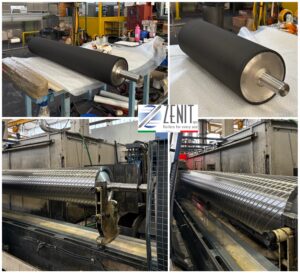
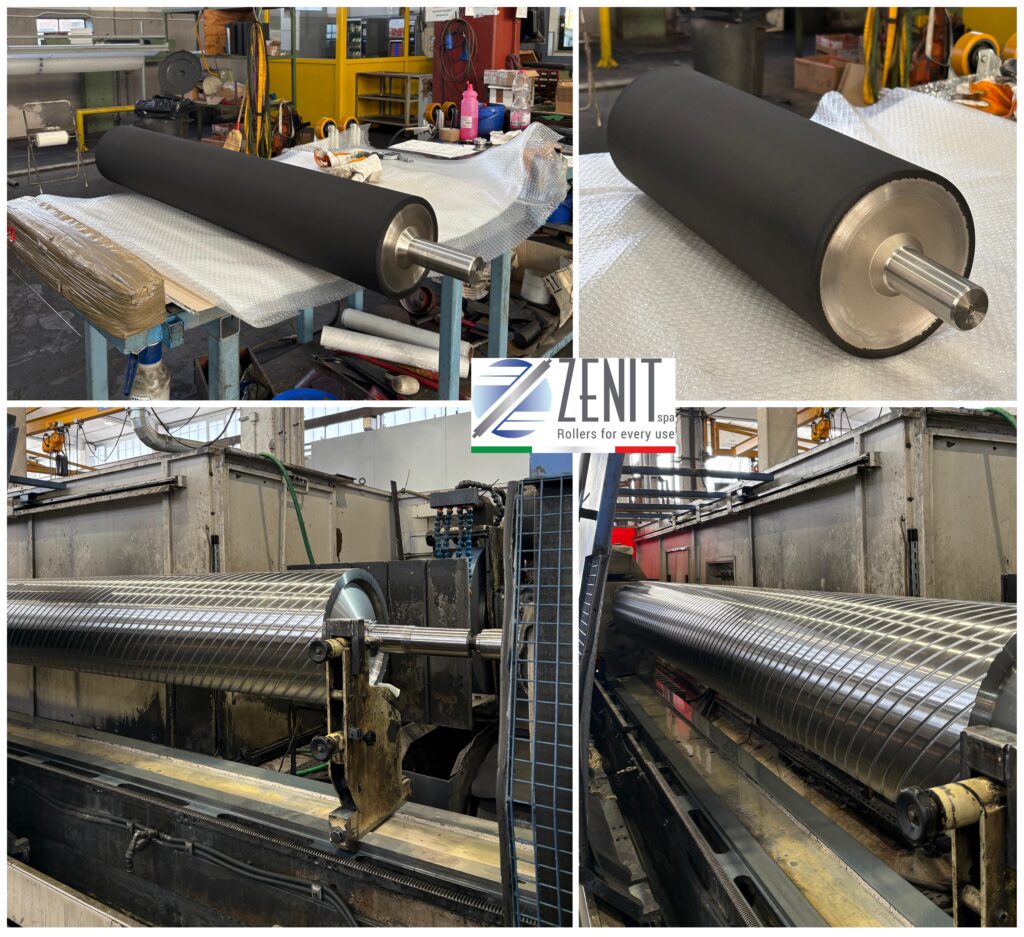
The photographs accompanying this article perfectly represent this concept. In the upper images, you can see steel rollers manufactured for food-industry end-of-line applications, made from AISI 316L stainless steel and featuring a special coating.
In the lower images, the rollers are intended for the wood treatment sector and feature a distinctive machining process: spiral grooves running along the entire length of the roll surface.
Two very different applications. Two different production requirements. Two different solutions.
And this is exactly what we mean when we talk about versatility.
Steel Rollers for completely different industrial applications
When we talk about steel rollers, it is easy to think of a standard cylindrical component with a simple and clearly defined function.
In industrial production, however, the reality is much more complex.
A roller used in a food-processing line may require a specific stainless steel grade, such as AISI 316L, together with a special surface coating designed according to the operating environment.
A component used for wood treatment may require completely different machining, such as spiral grooves distributed along the entire roll surface.
The manufacturing process therefore does not simply consist of producing a cylinder with a given diameter and length.
It means starting from the material, geometry, tolerances, surface requirements and intended application, and then identifying the most appropriate machining operations for the finished component.
This is where production experience becomes particularly important. ⚙️
From small diameters to large industrial components
Versatility is not limited to the sectors we serve.
It is also reflected in the dimensions of the components we can manufacture.
At Zenit, we can produce rollers with diameters ranging approximately from 80 mm up to 1200 mm, and lengths from 300 mm up to 7000 mm.
This wide dimensional range allows us to manufacture very different components: from relatively compact rollers to large industrial parts several metres long.
However, dimensions are much more than numbers on a technical drawing.
As diameter and length increase, so do the challenges associated with machining, handling, dimensional control and the management of the component throughout the production process.
For this reason, the ability to manufacture different sizes must be supported by a versatile machine park and by production processes capable of adapting to the characteristics of each individual component.
📏 80 mm, 1200 mm, 300 mm or 7000 mm: very different figures that clearly illustrate the variety of requirements we can handle.
Different materials for different requirements
Another important aspect of our production flexibility is the ability to work with different materials.
Carbon steels, stainless steels, special steels and aluminium alloys can be selected according to the characteristics required by the component and the environment in which it will operate.
Material selection can become decisive when a roller has to withstand corrosion, mechanical stress, wear, temperature variations or particularly demanding working conditions.
Our production therefore goes beyond steel.
We also manufacture aluminium rollers, which are particularly interesting when reducing the weight of the component is an important requirement while maintaining the necessary precision and performance.
The possibility of working with different materials therefore represents another key element of our manufacturing versatility. 🏭
A wide range of industrial sectors
The same flexibility can be seen in the industries for which our components are manufactured.
We produce flexible packaging rollers for applications where surface characteristics, dimensional accuracy and specific coatings can play an important role in the production process.
We also manufacture sheet metal rollers, designed for different stages of metal processing and treatment.
In the paper and converting industry, we manufacture paper and cardboard rollers, as well as components for paper mills, with solutions that can vary according to the machine and the specific application.
Another important area is the tissue industry, where tissue rollers are used in processes requiring precision, consistency and continuous operation.
Our experience also includes printing machine rollers, where geometric accuracy and surface quality can have a direct impact on the final production result.
This variety of applications allows us to constantly deal with different technical challenges and to apply experience gained across multiple industrial sectors. 🎯
Special rollers and shafts for non-standard requirements
There is another category of components where versatility reaches an even higher level: special rollers and shafts.
These components can require particular geometries, drilling, milling, special grooves, machining on the roll surface or combinations of several mechanical operations.
In these cases, the customer’s drawing becomes the starting point for analysing the component and identifying the most appropriate manufacturing solution.
Our experience includes the production of special rollers and shafts for different industries, using various materials and carrying out machining operations that go beyond those normally required for a standard roller.
This is precisely where the versatility of our machinery becomes particularly valuable. 🛠️
When the component goes beyond standard dimensions
One of the most interesting aspects of our work is the possibility of analysing requirements that fall outside our usual dimensional ranges.
The reference values of 80–1200 mm in diameter and 300–7000 mm in length describe our main production capabilities, but they should not automatically be considered an absolute limit for every possible application.
Depending on the characteristics of the component, different manufacturing solutions can be evaluated.
When we receive a non-standard request, we analyse the drawing, material, dimensions, tolerances, machining requirements and any challenges related to handling or dimensional inspection.
Only after this evaluation can we determine the most appropriate way to manufacture the component.
This approach allows us to look beyond standard dimensions and assess whether a particular requirement can be addressed through our available production resources and technologies.
Versatility as a manufacturing skill
The wide variety of components we manufacture is therefore not simply a characteristic of our business.
It is a manufacturing skill developed over many years.
Every new component brings a different combination of materials, dimensions, tolerances, machining operations and intended applications.
Some rollers require conventional machining. Others need special grooves, coatings, heat treatments or complex geometries.
And this constant variation is precisely what makes our work challenging and stimulating.
From steel rollers for food-industry applications to components for wood treatment, from aluminium rollers to special solutions, from relatively small diameters to components several metres long: every production represents a new combination of skills, machinery and technologies.
🔩 Our strength lies precisely in this: we do not manufacture the same component over and over again. We manufacture different components while maintaining the same attention to quality and precision.
In industrial mechanical manufacturing, versatility does not simply mean being able to do many things.
It means being able to adapt production to the customer’s actual requirements, analysing each component individually and identifying the most effective manufacturing solution.
That is what makes our work interesting.
And that is also why, when a request falls outside the usual standards, we believe it is worth analysing.
Because behind every roller there is a different application. And behind every application there may be a solution we have not manufactured before. 🚀
At Zenit, this approach is supported by a production facility of approximately 20,000 m², including 10,000 m² of covered space, and by a machine park designed to handle a broad range of machining requirements.
The result is a production philosophy based on flexibility, technical expertise and the ability to respond to different industrial needs.
Different sectors. Different materials. Different dimensions. One manufacturing partner.