
🔍 Ra below 0.2 µm: final inspection of our chrome-plated rollers for flexible packaging
A mirror finish is not enough: before they leave our workshop, these chrome-plated, ground and tape-finished rollers for flexible packaging go through the phase that matters most to us, inspection.
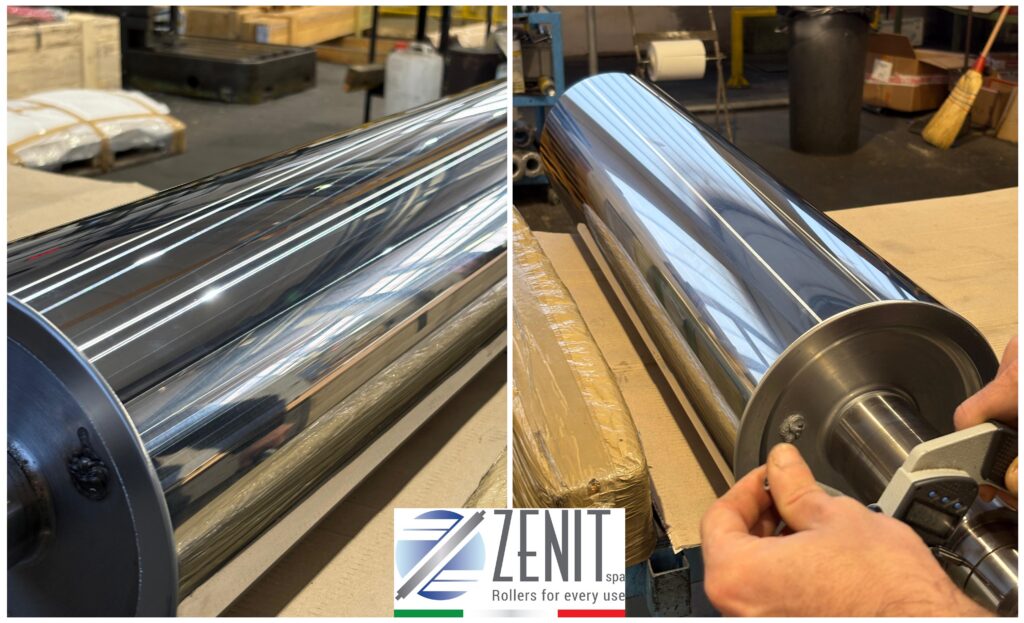
This week’s photo shows it clearly. On one side, the polished roller face reflecting the shop floor; on the other, the hands of one of our operators checking the journal diameter with a digital micrometer. Two images telling the same story: the moment a part stops being “work in progress” and becomes a roller ready for the customer.
The target for this order was clear: a surface roughness Ra below 0.2 µm. A value that is never reached by chance and never taken for granted. It is measured.
✨ Why the surface matters so much on rollers for flexible packaging
Anyone who converts plastic films, laminates and thin aluminium foil knows it well: every imperfection on the roller is transferred to the material. A micro-scratch, a duller area, a barely visible ripple can turn into a visible defect on the film, a crease, or a variation in the thickness of the adhesive or coating layer.
That is why surfaces intended for converting need a very fine finish. An Ra below 0.2 µm means a surface whose profile peaks and valleys are so small that contact is uniform along the whole face. The film runs smoothly, pressure is distributed evenly and the quality of the finished reel improves.
The same principle applies to printing machine rollers, where surface regularity directly affects ink transfer, and to paper and board rollers, where constant contact with the web is just as decisive.
🛠️ Chrome plating, grinding and tape finishing: three steps, one result
The result you see in the photo comes from a precise sequence of operations, each with a clear job to do.
Grinding. The roller body is ground to bring diameter, cylindricity and concentricity within the required tolerances. This is the geometric foundation for everything that follows.
Chrome plating. On steel rollers like these, the hard chrome layer provides surface hardness, wear resistance and corrosion protection. After plating, the roller is ground again to bring the geometry back to its final value.
Tape finishing. This is the superfinishing step: an abrasive tape with progressively finer grit works the chrome surface until roughness drops. This is where the Ra below 0.2 µm target is reached, and where the mirror look appears that, in the photos, reflects our shop floor.
Each step prepares the next. If grinding is not right, tape finishing cannot make up for it; if the chrome layer is not even, the final surface will never be uniform. That is why we treat the three operations as a single process, followed by the same team from start to finish.
📏 The inspection phase for our rollers for flexible packaging
This brings us to the moment captured in the photo. Inspection is not an add-on to production: it is what gives value to all the work done before.
On each of the rollers for flexible packaging in this order we check:
📐 dimensions, starting with the journals, measured with a digital micrometer as you can see in the picture;
🔄 concentricity between roller face and journals, because a roller that runs well on the machine is first of all a coaxial roller;
🔬 surface roughness, measured with a roughness tester to certify the required Ra value;
👁️ surface appearance, inspected visually under grazing light to spot any marks or haze.
Only when every value is within specification does the roller move on to packing. You can see this detail in the photo too: the chrome body rests on cardboard and is already partly protected by film, because such a delicate surface must be shielded from knocks and scratches from the very first moment.
🏭 A method we apply to everything we produce
The rigour we bring to this order is the same we use for everything that leaves our workshop. We apply it to steel rollers for general industry, to aluminium rollers, where low weight and low inertia are essential, and to sheet metal rollers, which work under heavy loads.
The same goes for tissue rollers and paper mill rollers, where sizes grow but precision must stay the same, and for the special rollers and shafts we manufacture to the customer’s drawing. We are manufacturers: the customer gives us the drawing and we turn it into a finished, machined and inspected component.
Materials change, diameters and lengths change, required finishes change. Our approach does not: every job ends with a check.
🤝 Why choose Zenit for rollers for flexible packaging
Working on surfaces with Ra below 0.2 µm takes experience, the right machines and, above all, patience. Every roller we deliver comes with:
- machining carried out in our own workshop, from grinding to superfinishing;
- dimensional and roughness checks at the end of the cycle;
- packing that protects the surface during transport.
For flexible packaging producers, reliable rollers mean less downtime, less waste and consistent reel quality. That is the contribution we want to make to our customers, order after order.
📩 Contact us
Do you have a drawing to manufacture, or rollers that need chrome plating and superfinishing? Write or call us: together we will define operations, finishes and lead times to get the result your line requires.